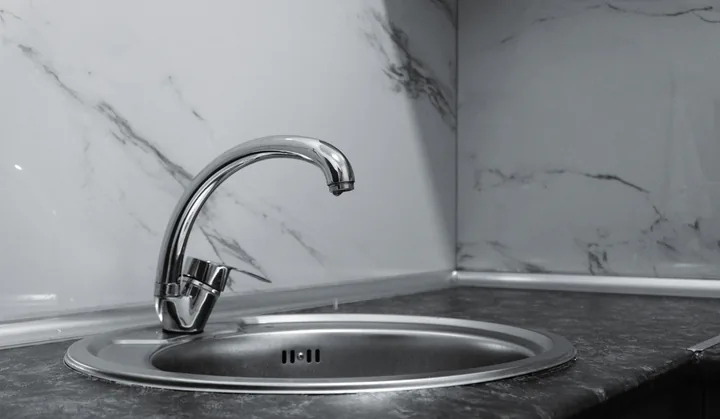
Mixer symptoms
Four cases wesee often.
Each one of these points at a different part inside the mixer.
01
It drips after closing
If it keeps dripping with the handle fully closed, the ceramic discs inside the cartridge no longer meet cleanly. A single grain of grit is enough to score that face and keep the drip going.
02
The handle has gone stiff
A mixer that needs force to move has lost the grease inside it, or deposits have worked between the discs. Forcing it keeps breaking the cartridge, and you end up changing the mixer instead of a part.
03
The flow sprays sideways
When the flow breaks up and sprays to the sides, the small aerator at the tip is partly blocked. It is the easiest case of all, cleared by unscrewing the aerator and cleaning or replacing it.
04
Hot and cold are swapped
You open it towards cold and hot arrives, or the other way round. This follows a new installation with the two supplies reversed, or a cartridge refitted the wrong way up. The correction is simple and does not need a new mixer.
In short
The mixer work.
Service
Kitchen and bathroom mixer and tap repair
The parts
Ceramic cartridge, rubber rings, aerator, flexible tails
Types
Single lever, two handle, wall mounted, and hand shower
Where it applies
Kitchens and bathrooms in houses, flats and chalets
Hours
Daily, 6:00 in the morning to 12:00 midnight
The method
From the handleto the test.
Careful work on small parts, and all of it above the basin.
We close both angle valves
A mixer has two supplies, hot and cold, and both have to be closed. We then open the mixer to release the pressure still held in the two tails.
We lift the handle off
The handle is held by a small screw hidden under a plastic cap, and beneath it a ring clamps the cartridge. That comes off with the right tool so the mixer body is not scarred.
We change the cartridge
The old cartridge comes out and its seat is cleaned of deposits, because a new cartridge dropped onto a dirty seat gives you the same drip again before long.
We open it and check both
Both valves open, we run hot, cold and every position between, and we look under the basin while it runs to be sure the tails are not weeping.
The detail
Two ceramic discsinside a mixer.
A single lever mixer works on two ceramic discs, one fixed and one moving with the handle. They are lapped so precisely that contact between them shuts the water with no rubber involved at all. It is an excellent design with a long life, and its only weakness is that it cannot tolerate anything hard passing between the faces.
That is where most problems begin. Grit or deposits carried in the water get between the discs and score the polished face, and once it is scored the contact is no longer tight and the drip starts. Which is why a dripping mixer is not fixed by tightening the ring. It is fixed by replacing the whole cartridge.
Water here leaves deposits on any surface it dries on. You see them as white scale around the spout and on the small aerator at its tip. That aerator exists to mix air into the flow and give a soft stream, and once it is partly blocked the stream turns into a scattered spray that throws water outside the basin.
A wall mounted mixer sits differently. Its body is buried in the wall with only the plate and the handle showing, so its cartridge is changed from the face with no breaking, as long as the original installation was done properly. If the buried body itself has failed, reaching it does mean opening up, and we tell you that before anything starts.
External links for referenceMinistry of Electricity and Water (the public water network in Kuwait)
Questions
Asked aboutmixers.
If the body is sound and the handle is solid, changing the cartridge is enough and brings it back to new. A full replacement is for a cracked body, flaking chrome, or a model with no parts available for it.
That is the small aerator at the tip. Deposits block part of its mesh and the flow pattern changes. It unscrews by hand or with a small spanner and is cleaned or replaced. It is the simplest case that reaches us on mixers.
Either the two tails under the basin were crossed, or the cartridge went back in the wrong way round. Both are corrected on the same visit with no parts changed. Tell us it started after a new install, because that detail saves time.
In most cases yes. The cartridge and the seals change from the face once the plate and handle come off. Breaking only enters the picture if the buried body itself is damaged, or the original install left no room to reach it.
It is not normal, and it is an early warning. The grease inside the cartridge has dried or deposits have worked between the discs. Changing it while it is stiff is easier than changing it after it breaks inside the body.