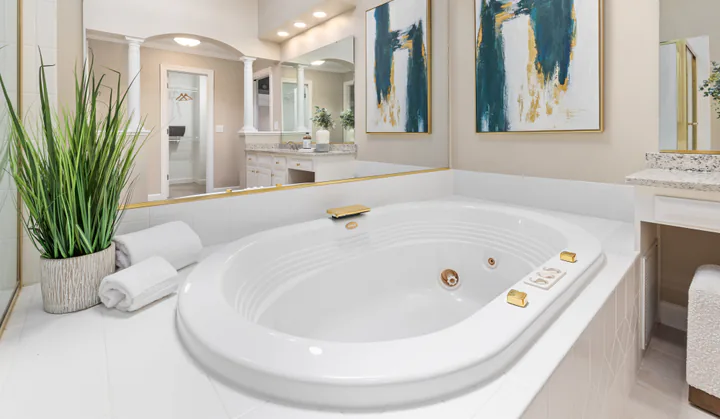
Before it goes in
Four things tosettle first.
These are settled before the purchase, because changing them later means breaking.
01
An access panel for the pump
The pump and the circulation loops sit under the tub, and they need a panel to reach them from the side. A jacuzzi tiled in completely means any future repair starts by breaking that tiling.
02
A supply that fills it
A jacuzzi holds more than an ordinary bath, and filling it off a weak run takes so long that the first water cools before it is full. Pressure and pipe bore have to be checked before fitting.
03
A waste that empties it
A jacuzzi waste carries more, and it needs correct fall to the nearest point. A slow waste leaves water standing inside the circulation loops after emptying, and that produces odour over time.
04
A floor that carries it
A jacuzzi full of water with someone in it is heavy, and it needs a fully supported base rather than four feet on tiling. Level matters more here than on a bath, because the loops have to drain themselves.
In short
The jacuzzi work.
Service
Jacuzzi installation with water and waste connection
Included
Base support, supply, waste and trap, access panel
Electrical side
The pump's electrical connection is an electrician's work, not ours
Where it applies
Houses, flats and chalets
Hours
Daily, 6:00 in the morning to 12:00 midnight
How we fit it
From the base tothe first run.
An order that leaves the pump reachable at the end of it.
We check supply and waste
We measure the pressure arriving and the position and fall of the waste outlet, and compare both against what the tub needs before anything is set in place.
We build a supporting base
A base is prepared that supports the tub across its whole area and levels it, leaving enough room beneath for the pump and the loops.
We connect and leave the panel
Water and waste are connected and the loops arranged so they drain themselves, and the position of the access panel is set before any tiling goes around the tub.
We fill it and empty it
The tub is filled to its working level and every joint is checked, then it is emptied completely to confirm no water is left standing inside the loops.
The detail
The loops underthe tub.
Inside, a jacuzzi is an ordinary tub with a network of flexible loops beneath it carrying water from the suction points to the jets, driven by a small pump. That network is the whole difference, and it is also the source of every problem that arrives later, because it is hidden under a heavy tub in a finished bathroom.
The single most important thing in the installation is access. The pump is a mechanical part and will need attention one day, and the loops themselves may need flushing. A jacuzzi tiled in on every side with no access panel stops being a serviceable unit and becomes one where every job starts with breaking.
Level and draining are linked. Loops arranged properly fall towards the drain point, so emptying the tub takes what is inside them with it. If the tub sits out of level, or the loops are routed in a way that creates pockets, water stands in them between one use and the next, and that is the best known jacuzzi complaint after a while.
A chalet brings its own consideration. Use is intermittent and the tub stands empty for long stretches, so washers and rubber rings dry out and stiffen, and then the first run after the gap brings every leak out at once. Which is why a jacuzzi in a chalet needs an arrangement that makes access easier, not harder.
External links for referenceMinistry of Electricity and Water (the public water network in Kuwait)
Questions
Asked aboutjacuzzis.
Yes, the pump needs its own electrical supply, and that is electrical work rather than ours. We prepare the pump position, the water, the waste and the access panel, and an electrician makes the connection. Say so early so the sequence is arranged properly.
It can be done, but three things get checked first: the size of the space, whether the existing waste is adequate, and whether there is room under the tub for the pump plus an access panel. An ordinary bath needs none of those, so the swap is not always a straight one.
Yes, and we treat it as a basic part of the installation. Without one, any work on the pump or the loops means breaking the tiling around the tub. The panel is made neatly to suit the bathroom and opens and closes easily.
Usually air has entered the loops, a suction point is partly blocked, or the water level is below what the jets need to run. All three are checked through the access panel, and most cases are dealt with without lifting the tub.
Yes, chalets are inside our coverage. One note for a chalet: because it stands empty for long stretches, the installation is best arranged so the pump is easy to reach, and the tub and its loops should be emptied each time before the chalet is closed up.