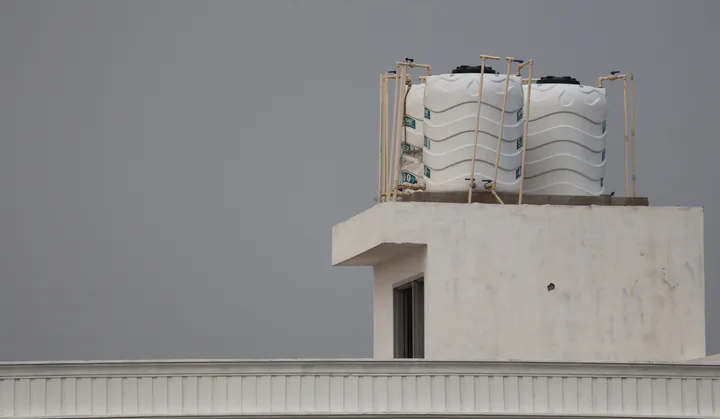
Tank symptoms
When a tank needscleaning.
A tank does not complain out loud. It complains through the water leaving it.
01
The taste or smell changed
If the taste or the smell changes at every tap at once, the source is shared, and the first place to look is the tank rather than a tap or the filter fitted to it.
02
Grit in the tap aerator
Unscrew a tap aerator and find fine grit in it, and sediment is moving off the tank floor. It lifts whenever the level drops and the draw on the tank gets stronger.
03
The lid is broken or missing
An open or broken lid lets Kuwaiti dust straight into the tank, and daylight in with it. Between them they spoil the water inside a tank that is otherwise perfectly sound.
04
Green on the inside wall
Green growth needs light. Seeing it inside a tank means light is getting in through a translucent lid, a crack or an open vent, and cleaning alone will not stop it returning.
In short
The tank work.
Service
Water tank cleaning and washing
Tank types
Roof and ground tanks, polyethylene, fibreglass and concrete
The work includes
Draining, lifting sediment, wiping walls, rinsing, checking the lid
Where it applies
Houses, blocks, complexes and chalets
Hours
Daily, 6:00 in the morning to 12:00 midnight
How it is done
From empty backto full.
A tank is cleaned empty. It cannot be cleaned with water in it.
We close the inlet and drain
The filling line is closed and the tank is drained through its drain valve or with a small pump, until only the layer on the floor is left.
We lift the sediment out
The layer on the floor is lifted out whole rather than stirred, because stirring it with water spreads it back across the walls and into the outlet.
We wipe walls and roof
The inner walls and the underside of the roof are wiped, because the film that clings above the water line is what comes back down with the first refill.
We rinse and check the lid
A final rinse leaves through the drain valve, then the lid, the openings and the float are checked, and we tell you if anything needs changing before it fills.
The detail
Why a tank getsdirty at all.
The water reaching a house is not perfectly clean even when it looks clear at the tap. It carries fine particles from dust and from the network itself, and those settle on the tank floor because the water inside is close to still. Over time they build into a layer, and that layer is the first thing lifted when the level drops and the draw gets stronger.
Dust is a major factor in Kuwait. An open opening, a broken lid, or a vent with no mesh means dust entering directly from above, especially in windy spells. That is why checking the lid belongs to the cleaning job, because a tank cleaned today gets dirty again quickly if it is open to the air.
Light plays a different role. Green growth cannot start in the dark, so a fully opaque tank with a sound lid will not see it however long it stands. A tank with a translucent lid, or a crack letting daylight in, will show it again after cleaning unless the light is dealt with too.
Heat makes both worse. A tank on a roof under summer sun warms right through, and warm water speeds up anything growing in it and gives you hot water from the cold tap in the afternoon. A tank with an insulated cover, or one standing in shade, stays calmer and dirties more slowly.
External links for referenceMinistry of Electricity and Water (the public water network in Kuwait)
Questions
Asked aboutwater tanks.
We do not give a fixed schedule, because conditions differ. An exposed roof tank with a weak lid needs it more often than one enclosed in a room. The practical rule is simple: when the taste changes or grit appears in the tap aerators, it is time.
It has to be emptied. Real cleaning means lifting the layer off the floor and wiping the walls, and neither can be done with water in the way. We drain it on the same visit, so you do not need to do it beforehand.
Yes, and it is better to do both on one visit. The ground tank feeds the roof tank through the pump, so cleaning the upper one alone means it fills again from a tank that has not been touched, and the result does not last.
A new tank needs a rinse before first use, because it arrives carrying transport dust and sometimes manufacturing residue. That is a simple rinse rather than a full clean, and it makes a difference to the taste of the first fill.
Usually yes. A roof tank under direct sun warms right through, and an exposed cold run on the roof adds to it. Cleaning will not change the temperature, but covering or shading the tank and insulating the exposed run makes a clear difference.