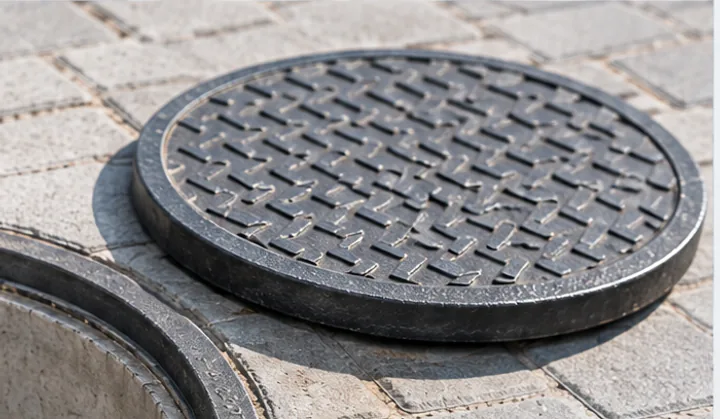
Cover warnings
When a cover hasto be changed.
A failing cover is a hazard to feet and to tyres, and it gives warning before it breaks.
01
It knocks under a wheel
A knock every time a car passes over it means the cover no longer sits fully on the frame seating. Repeated movement wears the seating wider and eventually cracks the cover.
02
The frame sits below the paving
A cover sunk below the level of the interlock around it collects water on top, and that water plus the grit it carries goes into the chamber every time the area is washed.
03
The cover is missing
An open hole, or one covered with a board or a slab, is an immediate danger, especially to children. The opening needs a cover made to that frame, not whatever cover happens to be to hand.
The fitting, short
Cover work in short.
Service
Installing and replacing manhole and chamber covers
The shape
Cover and frame share one shape and size
Material
Ductile iron or composite, depending on the spot
Chosen by location
A footway, a driveway or a road
The level
Set flush with the paving around it
Hours
Daily, 6:00 in the morning to 12:00 midnight
How we fit it
From measuring tobedding down.
Four steps, and the first is measuring, not buying.
We measure hole and frame
We measure the clear opening, the frame size and its height against the ground. A cover not matched to its frame either rocks or stands proud, and both bring the same fault straight back.
We look at the frame
The frame is bedded in mortar and carries the load. If the seating is worn or the bed under it has broken up, it comes out and goes back properly, because a new cover on a tired frame never stays.
We set it level with the paving
The frame is raised or dropped until it is flush with the paving around it, and the blocks are cut to a clean line against it so no gap is left for water and grit to gather in.
We load it before we leave
The cover goes on and we pass over it with the load it will actually see, a wheel or a footfall, and listen for movement. A correctly seated cover makes no sound at all.
Cover and frame
Why the shape neverchanges.
A cover sits inside a frame, and the frame defines the shape of the opening. The opening and the cover therefore always share one shape and one size; there is no case where a cover of one shape serves an opening of another. That is the first thing we check, because most requests arrive with an approximate size rather than a measured one.
Public manhole covers in Kuwait are round for a geometric reason: a round cover cannot drop through its own opening at any angle you turn it, it needs no alignment, and it can be rolled instead of carried. Openings inside paved yards and driveways are often the recessed tray type instead, filled with the same interlock blocks so the cover almost disappears.
Material matters. Ductile iron has become the regional preference over grey cast iron because it is lighter for the same load class and copes better with heat, grit and vibration. The load class itself follows the location: a footway is not a driveway, and a driveway is not a road carrying lorries.
The most common mistake we see is a new cover fitted to a tired frame. The frame carries the whole load and passes it into the concrete beneath, so if the bed under it has broken up or the seating is worn, any new cover will move, knock and crack in time. Resetting the frame matters more than the cover itself.
External links for referenceKuwait Municipality (public health and drainage requirements)
Questions
Asked aboutcovers.
Cover the opening with something heavy that cannot slide, mark it so it shows after dark, and keep children away. Do not use a light board, because it shifts under a foot or a tyre and is more dangerous than an open hole.
Better that we measure first and bring one to the right size and the right load class for the spot. A cover bought before measuring usually turns out over or under size, and that is most of what reaches us.
Flush with it. A cover standing proud catches feet and takes a hit from every tyre, while a sunken one collects water that runs into the chamber carrying grit with it. Level prevents both.
Anything inside your boundary we work on directly. One in the public street belongs to whoever maintains the road, and we would tell you to report it, though we can look and tell you the size and the state it is in.
No. A cover should seat tightly and let no air past. Odour at the edge means the seating is worn or the cover is not the right one, and sometimes that the chamber under it has filled.