The signs
When the blockage isin the main line.
Not every blockage sits in the main line. These are the signs that tell them apart.
01
Several drains at once
If water backs up in two bathrooms, or in a bathroom and the kitchen together, the problem is usually past the gully, because each one has its own branch feeding a single shared line.
02
The toilet rises with the washer
The main line cannot take the volume a washing machine pushes out, so it comes up at the lowest opening it can find, usually the toilet or the floor drain beside it.
03
It comes back on a cycle
If you clear the gully and the blockage returns two or three weeks later, the cause is usually the line itself: build up on the pipe wall, a bad fall, or a crack that catches everything passing it.
In short
The short version.
Service
Main sewer and drain line unclogging
Where it applies
Houses, flats, blocks and complexes
Method
Drain rods and a hand auger, with tanker suction when the line is full
Coverage
Every area of Kuwait, across all six governorates
Hours
Daily, 6:00 in the morning to 12:00 midnight
How it works
Clearing the mainline, step by step.
Four steps, in the same order every time.
You call and describe it
Tell us where the water is coming up, how many places at once, and when it started.
We open the nearest chamber
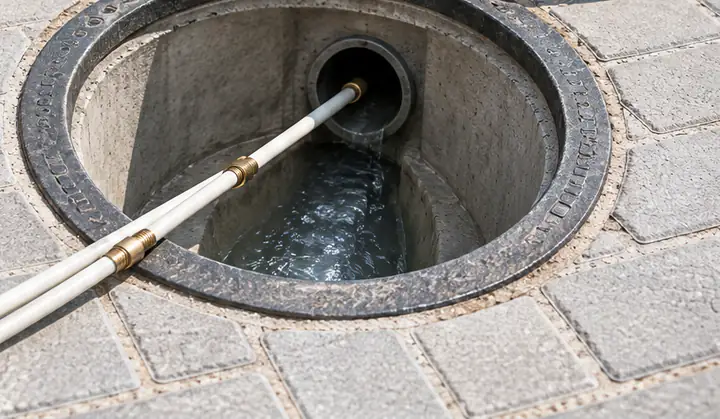
We lift the round cover and read the water level in the channel. That tells us whether the blockage sits above the chamber or past it.
We rod it from the right side
The rods go in at the pipe mouth and turn clockwise, so the joints tighten instead of unscrewing, until they reach what is holding the flow.
We run the water and check
We run water from the highest point in the house and watch it pass through the channel in front of you, then tell you what caused it.
The detail
Why a main lineblocks.
The main line is the pipe that gathers the drainage of the whole house and carries it to the inspection chamber, and from there to the network or the cesspit. Every bathroom and kitchen branch feeds into it, and it is wider than any of them, which is why it is never blocked by a hair or a piece of soap. It is blocked by something that builds up over months.
The cause we see most is grease. Cooking oil goes down hot and liquid, then cools against the pipe wall and sets as a layer that catches everything passing it: wipes, bags, hair, food waste. The layer narrows the bore a little at a time until only a small channel is left, and the first day more water than usual goes down, it closes completely.
The second cause is the line itself rather than what passes through it. Too little fall lets the water move slowly, so solids drop out before they get anywhere. Too much fall lets the water run ahead of the solids and leave them behind in the pipe. A crack or a sag in one length makes a pocket that collects everything travelling over it.
That is why we separate clearing from diagnosis. Rodding opens the run today, but if the cause is a grease layer built up over years or a break under the ground, it will come back. We tell you which one it is, from what the chamber shows and from how the rods come back, so you know whether you need scheduled cleaning or work on the line.
External links for referenceKuwait Municipality (public health and drainage requirements)
Questions
Asked about themain line.
If water comes back in more than one place at the same time, or the toilet rises when the washing machine drains, it is the shared line. If one gully is slow and everything else drains normally, the blockage is usually in that branch.
Draining on its own means the run narrowed, not that it opened. A blockage that clears itself comes back, and each time there is less bore left. It is easier to deal with while it is still a narrow run than once it is shut and the water is in the house.
No. The work is done through the inspection chamber and the pipe mouths that are already there, and the rods go in from those. Breaking only comes into it if there is a crack or a sag in one length, and that is something we tell you about before anything else happens.
Rodding opens the blockage inside the pipe. The tanker pumps out the water and solids standing in the cesspit or the manhole when it is full. Sometimes the line will not run because what is downstream of it is full, and the job needs both together.
Call and tell us it is the same line a second time. A return means the cause is the pipe rather than what went through it, so we look at the line itself and find where the pocket is, instead of repeating the same work for the same result.