Signs it needs it
When pumping aloneis not enough.
These are the signs that a chamber needs washing rather than another level drop.
01
The smell outlasts the pumping
The level came down and the lines run again, but the smell around the cover stays. What produces it is the layer stuck to the walls, and that does not come out with the water because it neither floats nor pours.
02
A hard crust on the surface
Lifting the cover to find a bound layer sitting on the water instead of a liquid surface says the chamber has gone a long time without cleaning, and that pumping alone will pass under it and leave it there.
03
The pipe mouth looks narrowed
The inlet or outlet mouth reads smaller than its real bore, or its rim is coated with deposit. A narrowed mouth means the chamber fills again quickly however much is pumped out of it.
Cleaning in short
The washing, short.
Service
Cleaning of cesspits, manholes and chambers
What gets cleaned
Walls, channel, benching and the pipe mouths
When it applies
After pumping, or as scheduled care of a pit
Method
Scraping and washing down, with the residue lifted
Where it applies
Houses, chalets, blocks and complexes
Hours
Daily, 6:00 in the morning to 12:00 midnight
How we clean
From the cover tothe wash down.
Four steps, and the order matters so nothing we lifted goes back down.
We open and skim the top
The round cover comes off and the surface layer is taken first, because letting it drop as the level falls would lodge it in a pipe mouth and make a new problem.
We take the level to the base
The level comes down in stages until the base and the channel show. Nothing is cleaned while water still covers the wall, because you cannot tell what is stuck from what is merely wet.
We scrape walls and benching
The bound layer is scraped off the wall and off the benching around the channel, then washed down from the top so everything released runs straight into the channel.
We check the mouths and close
Inlet and outlet are checked clean at their full bore, then water is run from inside the house and watched crossing the channel before the cover goes back on.
What builds up
The layer that willnot pump out.
Any chamber or pit working for a long time settles into three layers: a floating layer of fats, grease and soap on top, water in the middle, and a heavy layer on the base of sand, silt and anything denser than water. Pumping removes the water and part of the heavy layer, and leaves whatever has bound itself to the wall.
That bound layer is what makes the smell. Concrete is porous, grease soaks into it, and it stays a source of odour long after the level has been taken to the base. Scraping and washing take it back to a clean surface, and that is the difference between a chamber that is clean and one that is merely empty.
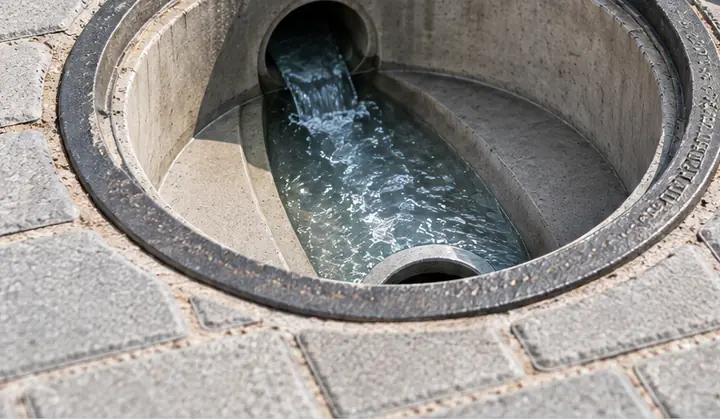
In inspection chambers there is a second thing people miss: the benching around the channel. Its fall is meant to return anything landing on it to the flow, but once it is coated the surface turns rough and holds material instead of shedding it. Cleaning gives the benching its original job back.
The pipe mouths are the last thing we look at. A mouth narrows from the rim inwards, and that narrowing reduces the bore of the whole run at its most important point. When we say a chamber is clean we mean both mouths are at full bore, the channel is running and the wall is not giving off odour, not simply that the level went down.
External links for referenceKuwait Municipality (public health and drainage requirements)
Questions
Asked aboutcleaning a pit.
Pumping drops the level and takes out what is liquid. Cleaning removes what has bound itself to the wall and the base and opens the mouths. You can pump without cleaning, but you cannot clean before the level is down.
We would not advise it. A closed chamber holds air you should not breathe, the iron cover is heavy and needs a hook and the right stance, and the wall is slippery. We open it, let it air, and work from outside the chamber.
It depends on the size of the pit, how many people use it and what goes into it. The practical signal is the smell returning soon after pumping, or a bound crust on the surface the moment you open it.
Usually yes. Water coming up under the cover leaves a mark on the interlock around it, which means the chamber has filled to the top at least once. We wash around the frame after the chamber itself is cleaned.
Yes, and it is a good moment because the house is empty and access is easy. We open every point, look at the channel and the mouths, clean what needs it, so you start knowing the state of the run.