Three questions
What decides themethod first.
Three pieces of information settle the method, and all three come out on the call.
01
What it is made of
Something solid, hair wound tight, or grease built up slowly. Solids get pushed, wound hair gets cut, grease gets washed.
02
How far from an opening
The distance to the blockage decides whether it can be reached at all. A basin trap is close, a blockage past the chamber is not.
03
The bore of the line
A narrow run for one fixture is not a main line for a whole house. The wider the bore, the less a small head achieves.
The first method
Rods: a direct pushdown a short run.
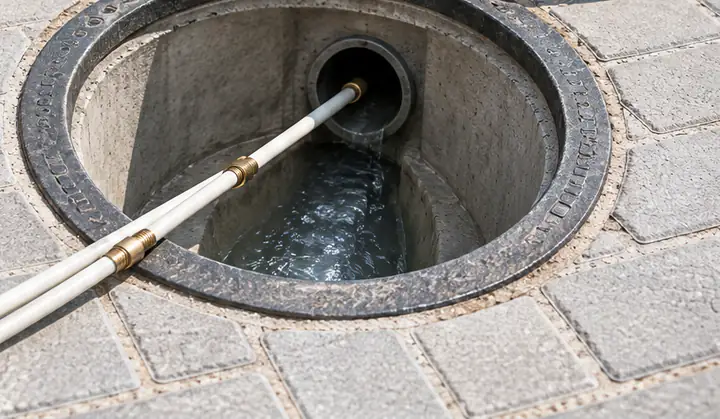
Rods are stiff lengths that screw together, tipped with a rubber disc or worm screw. They enter through the chamber's pipe mouth, turned clockwise so joints tighten, and you feel where the pocket is.
They suit anything near the way in: a bag, wipes, wound hair, or a mass at a bend. They fall short on distance, and on grease, which they only push through.
The second method
The spring: a cableturning inside.
The spring is the market name for a cable machine: a flexible cable on a driven drum that follows bends a rod cannot pass. A small cutting head does the work.
It suits narrow, short runs: the basin, shower, toilet and washing machine drain, reaching further than rods. Its head is small next to a main line, so it opens a channel, not a clean wall.
The third method
Pressure: water thatwashes the wall.
Pressure clearing works differently. A hose carries a head with backward jets, and the water leaving them drags the hose up the line, washing the wall on the way back.
Its place is long runs and wide bores: a main line for a block, or a restaurant line packed with hardened grease. Every method enters through existing openings, without breaking anything.
Plainly: our kit is drain rods, a small cable machine and a tool bag, not a pressure unit on a vehicle, and we say so on the call. One case needs suction first, when a standing cesspit pushes water back.
On the methods
Questions aboutpicking a method.
A rod is stiff and pushes in a straight line. The spring is a flexible cable that turns and follows bends, reaching further along narrow runs.
No. Pressure is strongest against grease in long runs and wide bores. A simple basin trap blockage does not need it, since a small cable reaches it faster.
Usually the method opened a channel through the middle without removing the cause from the pipe wall. A return at the same point means the cause is the pipe itself.